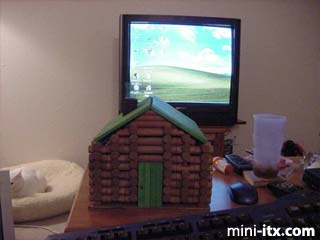
Looking back at this old Mini-ITX mod, it has occurred to me how simple it would be to adapt it to VIA's latest offerings. This log cabin case mod featured a VIA Mini-ITX motherboard. This could so easily be adapted to feature a VIA APC Rock motherboard.
VIA Technologies, Inc. designs and manufactures a slew of embedded products including ultra low votage CPUs, embedded motherboards and barebone systems. They also, of course, design the Mini-ITX, Nano-ITX, Pico-ITX and Em-ITX platforms that are widely used in the embedded market. This blog feed follows news and reviews on VIA embedded products, especially those available in Australia.
Sunday, October 13, 2013
Sunday, September 29, 2013
VIA now offering unofficial Mozilla OS
VIA Embedded's APC range of computers was launched with the Android OS. They're soon to offer the unofficial version of the new Mozilla OS called Boot 2 Gecko.
The $79 APC rock and the $99 APC Paper are beautifully designed, embedded platforms, offering a quick way for developers to develop new software for operating system such as Android and Mozilla. More at Liliputing.com
Monday, September 23, 2013
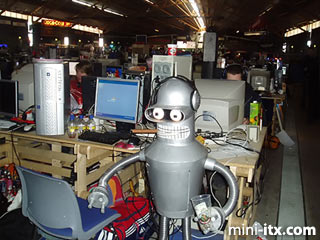
Case mod memory lane #7: Bender case
I actually saw this case mod in person at QuakeCon in 2005. It looks more like a movie prop than a computer. The dimensions are just right and the eyes and mouth have the right personality. This is one mini-ITX case mod where the VIA motherboard inside is not the star of the show!
"After the platform was made, everything went like a dream. The parts slotted right inside. I can thank myself for this due to careful planning and taking my time with the project. It actually took 3 months longer than planned." - Mini-ITX.com
Sunday, September 15, 2013
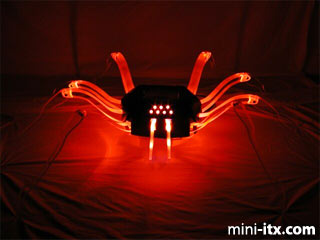
Case mod memory lane #6: The Spidercase
This mod is certainly one of the most creative and unique. Rather than putting a VIA EPIA Mini-ITX motherboard inside something that already exists, this mod was made from scratch. It was not without cost ...
"After cutting openings for the legs, I had to figure out how and what to make the legs with. Originally I had planned for the aluminum look but finding a cheap CNC cutter + blocks of aluminum in only a few days seemed nearly impossible. So I decided to go with my reliable source of acrylic at www.tapplastics.com. Since there was a local store within a mile of my house, I quickly made some templates and ran off to get some acrylic. About halfway through cutting the legs out, I stuck my middle fingertip into a table saw and found out first hand why people wear gloves. One stitch and 3 hours later I was back in the garage cutting again. I'll spare you the pictures. The thighs were 1-1/4" thick and only 6 were made at the time because the template picture I was going off showed only 6 legs on the spider. Later I changed it to 8. As I was cutting the lower portion of the legs, I routed my thumb and figured out for the second time why I should learn things the first time (wear gloves!!!@#). Since I couldn't use my right hand for the last few leg parts, I took them to Tap Plastics and they gladly cut out the shapes I needed cheap. This was after they laughed at me for cutting my hand for the 2nd time."
More on Mini-ITX.com.
"After cutting openings for the legs, I had to figure out how and what to make the legs with. Originally I had planned for the aluminum look but finding a cheap CNC cutter + blocks of aluminum in only a few days seemed nearly impossible. So I decided to go with my reliable source of acrylic at www.tapplastics.com. Since there was a local store within a mile of my house, I quickly made some templates and ran off to get some acrylic. About halfway through cutting the legs out, I stuck my middle fingertip into a table saw and found out first hand why people wear gloves. One stitch and 3 hours later I was back in the garage cutting again. I'll spare you the pictures. The thighs were 1-1/4" thick and only 6 were made at the time because the template picture I was going off showed only 6 legs on the spider. Later I changed it to 8. As I was cutting the lower portion of the legs, I routed my thumb and figured out for the second time why I should learn things the first time (wear gloves!!!@#). Since I couldn't use my right hand for the last few leg parts, I took them to Tap Plastics and they gladly cut out the shapes I needed cheap. This was after they laughed at me for cutting my hand for the 2nd time."
Sunday, September 1, 2013
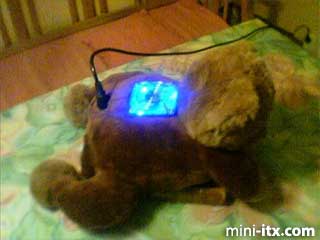
VIA case mod memory lane #5: The teddybear
It's all class this week with a look back at the computer case mod that has a teddy bear stuffed to the brim with a VIA EPIA-based computer.
Was that the best place for the power cord? Seriously though, it was good thinking to include a fan on the top. VIA embedded motherboards do run without passive cooling, but maybe not when they're inside a fur coat. More on Mini-ITX.com
Sunday, August 25, 2013
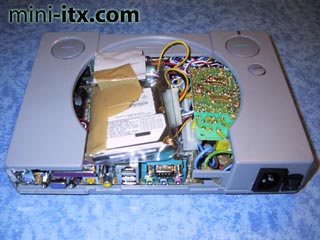
VIA case mod memory lane #4: The Playstation PC
It's ironic that consoles really do have the innards of a PC these days and in this mod, Per Samuelsson, gutted an old-school, grey Playstation and crammed inside a VIA EPIA Mini-ITX board 6GB hard drive, 256MB RAM, 145 Watt PSU, power switch, power connector and an extra fan. It was a tight squeeze.
"The EPIA mainboard fits exactly into a Playstation chassis, what luck! Of course I had to remove the gameports - to make them look like real gameports I filed them down until I had a 2.5mm thick frame, then glued the memory flaps into place and fitted the controller pins on black cardboard. Now they really looked like real Playstation gameports. I installed the Ram on the mainboard and tried to fit the cover. Fat chance Buster! It was too high. Dremel, Dremel, Dremel..."
It looks like someone's trying to smuggle something in there! Full story on Mini-ITX.com
Sunday, August 18, 2013
Case mod memory lane#3: The iGrill
Continuing on with the kitchen theme, this week we take a look at the George Forman grill that was turned into a PC back in 2005 by James Goldsmith.
James actually bought the grill new and what's the first crazy thing you have to do with a mod like this?
"Of course, the first thing to do when a new toy arrives is to completely take it apart. So 5 minutes with philips-head and pro-drive screwdrivers later, it was down to the bare components. With hindsight, I probably should have done this with some kind of due care and attention, as it took me as long again to figure out which bits belonged where. I had intended to use the original power cabling, and mod the psu to use them, but this proved unfeasible, as I had to slice the cabling in two just to open the damn thing up."
Yes, the VIA Mini-ITX platform has been the cause for parts of many machines to be strewn across people's living rooms in pursuit of the ultimate case mod. You can read more about this mod on Mini-ITX.com.
James actually bought the grill new and what's the first crazy thing you have to do with a mod like this?
"Of course, the first thing to do when a new toy arrives is to completely take it apart. So 5 minutes with philips-head and pro-drive screwdrivers later, it was down to the bare components. With hindsight, I probably should have done this with some kind of due care and attention, as it took me as long again to figure out which bits belonged where. I had intended to use the original power cabling, and mod the psu to use them, but this proved unfeasible, as I had to slice the cabling in two just to open the damn thing up."
Yes, the VIA Mini-ITX platform has been the cause for parts of many machines to be strewn across people's living rooms in pursuit of the ultimate case mod. You can read more about this mod on Mini-ITX.com.
Sunday, August 11, 2013
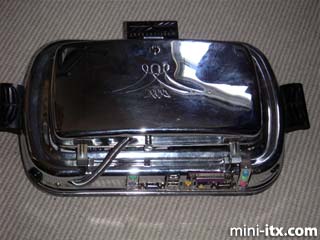
Case mod memory lane again: the waffle iron
The chrome casing to this waffle iron provided a classy look to an otherwise cooky mod for the VIA EPIA M1000.
Find out more on Mini-ITX.com.
Thursday, August 1, 2013
ARM and VIA embedded
ARM processors, as oppossed to x86 processors, have become the platform choice for a lot of things that were once the domain of low power processors like VIA's C3 and then C7 line.
VIA themself now have five product lines that feature ARM processors. They are:
What do all of these have in common? VIA Embedded Pico-ITX and Nano-ITX boards that feature ARM processors. ARM processors, coupled with VIA's expertise at embedded high quality and feature rich chips onto loa profile embedded boards, offer the best performance per watt solution available.
- ARM based VAB series of Pico-ITX boards
- VIA Alta DS digital signage solutions
- VIA ARTiGO embedded computers (Pico-ITX board inside)
- VIA M’SERV embedded computers (Nano-ITX board inside)
- Fanless AMOS series of embedded computers
What do all of these have in common? VIA Embedded Pico-ITX and Nano-ITX boards that feature ARM processors. ARM processors, coupled with VIA's expertise at embedded high quality and feature rich chips onto loa profile embedded boards, offer the best performance per watt solution available.
Wednesday, July 3, 2013
Introducing VIA Embedded's MagicView
VIA and S3 graphics have had a long collaboration in designing embedded graphics solutions. Their latest partnership, however, has seen the development of an Android based development software solution for digital signage. MagicView is an ...
“advanced digital signage solution developed by VIA Technologies in collaboration with S3 Graphics comprised of a VIA embedded system and content management software called MagicView. In comparison with other digital signage solutions on the current market which require high-performance CPU capability which lead to high costs to build up systems, VIA Magic Box supports hardware decoding acceleration technology and enhanced HD video playback of the most demanding HD video formats, including, WMV9, VC1 and H.264 at screen resolutions of up to 1080p.”
The Canadian company Capital Networks is the first company announced as a development partner using VIA's ALTA DS system and MagicView. [Source]
Labels:
Android,
digital signage,
MagicView,
S3 Graphics,
VIA embedded
VIA offering an ARM digital signage system
The ALTA DS System offers developers of digital signage systems a small, robust and easily programmable kit. The hardware features include:
- ARM Cortex-A9 System on Chip
- hardware acceleration for video
- HDMI and VGA (optional) ports
- 4 USBs
- one Ethernet
- 4GB eMMC flash memory onboard (expandable to 16GB)
- 1GB DDR3 SD RAM
This is a simple but effective solution for digital signage projects and the less complicated the hardware, the less can go wrong with it. [Source]
Labels:
ALTA DS,
ARM processor,
digital signage,
VIA embedded
Monday, July 1, 2013
The Mini-ITX cluster proves forever popular
Over on Mini-ITX.com, the right border of the popular site shows the most viewed content that day. Fourth on the list is a blast from the past, from February 2004, the build of the 12 node mini-cluster, powered by the VIA EPIA V8000.
The write-up of the project is no Dan Brown novel, so it must be the content that has people visiting so much some nine years later. Or maybe it's just that it looks so darn cool!
"I built a Mini-ITX based massively parallel cluster named PROTEUS. I have 12 nodes using VIA EPIA V8000, 800 MHz motherboards. The little machine is running FreeBSD 4.8, and MPICH 1.2.5.2. Troubles installing and configuring Free BSD and MPICH were few. In fact, there were no major issues with either FreeBSD or MPICH. The construction is simple and inexpensive. The motherboards were stacked using threaded aluminum standoffs and then mounted on aluminum plates. Two stacks of three motherboards were assembled into each rack. Diagonal stiffeners were fabricated from aluminum angle stock to reduce flexing of the rack assembly."
Thursday, June 20, 2013
As always, VIA gets an award
Taiwan's well-known golden company of the tech boom once again got an award at Computex and like many, many years prior it was for innovation. The VIA APC Paper embedded computer won the Computex 2013 d&i (design and innovation) award presented by the Taiwan External Trade Council (TAITRA) in cooperation with the International Forum Design Hannover (iF).
"APC Paper was awarded this prestigious honor for its groundbreaking use of new types of materials and form factor which pushes the boundaries of PC design in new directions. With special attention to an organic design, the cardboard encased APC Paper blends seamlessly into any home or office environment." - more.
| Which one is the PC? |
"APC Paper was awarded this prestigious honor for its groundbreaking use of new types of materials and form factor which pushes the boundaries of PC design in new directions. With special attention to an organic design, the cardboard encased APC Paper blends seamlessly into any home or office environment." - more.
Sunday, June 16, 2013
The cardboard box PC is back
I thought this was old news but apparently it was new news for some people when it was spotted at the recent Computex trade show in Taiwan. It's VIA's APC Paper Rock, first announced in January this year, but not arriving until Q3 2013.
Tom's Hardware has done a short write-up on the upcoming embedded delight.
"VIA has revealed the APC Paper. The APC Paper is basically an APC Rock board in a cardboard and aluminum box, which opens up like a book to show off the APC Rock board. When closed, it measures 204 x 98 x 28 mm."
Sunday, May 19, 2013
WonderMedia chips on VIA Pico-ITX board
The VAB-600 Pico-ITX board from VIA doesn't feature a VIA processor - or well not really anyway. Instead it features an ARM Cortex-A9 processor from VIA's subsidiary, WonderMedia. This has been paired up with WonderMedia's Mali-400 graphics. Overall this keeps the power consumption of the system down really low and the costs too, making suitable for an Android or Linux-based setup. 1GB of built in RAM should be ample, along with 4GB of storage.
Thursday, May 16, 2013
Rumours surface of a new single-board computer from VIA by July
After the success of the Raspberry Pi-like VIA APC Paper single board computer, its little wonder that VIA will follow up with new models. The Element14 community has this to say:
"What sets VIA’s new board above the Raspberry Pi (even though the Pi is smaller) is not only faster hardware but all the aforementioned connections which gives users more options regarding peripherals that can be connected including Wi-Fi via a USB dongle."
They seem to know quite a bit about this board that hasn't been announced yet!
"What sets VIA’s new board above the Raspberry Pi (even though the Pi is smaller) is not only faster hardware but all the aforementioned connections which gives users more options regarding peripherals that can be connected including Wi-Fi via a USB dongle."
They seem to know quite a bit about this board that hasn't been announced yet!
Monday, May 6, 2013
VIA's new Pico-ITX board comes with everything you need to in-vehicle setup
One of the first things that case modders thought of when VIA brought out the Mini-ITX motherboard was - let's put a PC in a car. Many kits and chassis and designs have come along since. VIA's latest Pico-ITX mainboard is designed for in-car, or in-vehicle use, as the snazzy title to VIA's Press Release attests: VIA Announces Latest VIA Pico-ITX Board to Jump Start In-Vehicle Innovation, VIA VAB-600.
Interestingly, this Pico-ITX board does not feature a VIA CPU; it has an ARM Cortex instead.
"Based on the ultra compact Pico-ITX form factor, measuring 10 cm x 7.2 cm, the VIA VAB-600 combines an 800MHz ARM Cortex-A9 processor with a built-in 2D/3D graphics engine, supporting OpenGL® ES 2.0, to deliver a smooth user experience and superb multimedia performance. Customers can leverage our starter kits which include a VIA VAB-600 Pico-ITX board, VAB-600-A I/O card, VAB-600-C TTL Converter card, 7” touch screen TTL panel, cables and 18W AC adaptor.
Rear I/O includes one Mini HDMI port, two Mini-USB 2.0 ports, one 10/100 Ethernet port and 1 12~24V DC-in jack.
On-board features include 4GB eMMC Flash memory, 1GB DDR3 SDRAM, one DVO connector for TTL or LVDS display, two COM ports, SPI, one USB 2.0 connector, one Mini Card slot (supports USB 2.0 connectivity for optional WiFi module VNT9271B6050), support for one SIM card slot, touch screen connector, front pin headers for line-in/out and MIC-in, I2C and GPIO pin header, and one battery charger connector with smart battery function."
Interestingly, this Pico-ITX board does not feature a VIA CPU; it has an ARM Cortex instead.
"Based on the ultra compact Pico-ITX form factor, measuring 10 cm x 7.2 cm, the VIA VAB-600 combines an 800MHz ARM Cortex-A9 processor with a built-in 2D/3D graphics engine, supporting OpenGL® ES 2.0, to deliver a smooth user experience and superb multimedia performance. Customers can leverage our starter kits which include a VIA VAB-600 Pico-ITX board, VAB-600-A I/O card, VAB-600-C TTL Converter card, 7” touch screen TTL panel, cables and 18W AC adaptor.
Rear I/O includes one Mini HDMI port, two Mini-USB 2.0 ports, one 10/100 Ethernet port and 1 12~24V DC-in jack.
On-board features include 4GB eMMC Flash memory, 1GB DDR3 SDRAM, one DVO connector for TTL or LVDS display, two COM ports, SPI, one USB 2.0 connector, one Mini Card slot (supports USB 2.0 connectivity for optional WiFi module VNT9271B6050), support for one SIM card slot, touch screen connector, front pin headers for line-in/out and MIC-in, I2C and GPIO pin header, and one battery charger connector with smart battery function."
Sunday, February 24, 2013
What better place to show off digital displays than Vegas?
Some lucky VIA employees with be attending the Digital Signage Expo in Las Vegas this week, showcasing a new system that would stand out on any Vegas sidewalk.
"VIA Technologies is highlighting DS-8, the new 8-channel digital signage media player that is ideal for digital menu board deployments. The player, combined with Popstar's Digital Media Manager (DMM), has the capability to operate and manage 8 discreet digital signage displays in a mixed-aspect ratio. The VIA DS-8 supports up to 8 HDMI or DVI outputs and HD graphics on multiple displays while still delivering true pixel by pixel resolution."
This is one of those systems that can play something across all screens and then switch back to displaying individual items on each screen.
You can see it at booth #1248 (VIA); and Booth #1062 (Ingram Micro) at the Digital Signage Expo 2013 in Las Vegas.
"VIA Technologies is highlighting DS-8, the new 8-channel digital signage media player that is ideal for digital menu board deployments. The player, combined with Popstar's Digital Media Manager (DMM), has the capability to operate and manage 8 discreet digital signage displays in a mixed-aspect ratio. The VIA DS-8 supports up to 8 HDMI or DVI outputs and HD graphics on multiple displays while still delivering true pixel by pixel resolution."
This is one of those systems that can play something across all screens and then switch back to displaying individual items on each screen.
You can see it at booth #1248 (VIA); and Booth #1062 (Ingram Micro) at the Digital Signage Expo 2013 in Las Vegas.
Thursday, February 14, 2013
Easy fit for the ARMTiGO
This sort of placement of an embedded computer keeps fairly secure from physical tampering and means that no extra space above and beyond the monitor has to be found for the computing muscle. The monitor itself becomes the focus of the device in question.
Wednesday, February 6, 2013
VIA ARMTiGO may be appealing to home enthusiasts but the market is in automation
The VIA ARMTiGO A800 is the world's smallest ARM based computer and although it has obvious appeal for HTPCs and having a small PC in the kitchen or kid's room, the real market is in embedded applications, argues Softpedia.
"Small really does mean small when it comes to health care technology, digital signage, surveillance and other embedded applications.
Client organizations can hide the system anywhere they wish, even behind a monitor, or just leave it on the wall for everyone to see, provided they have a VESA mount (7.5 cm x 7.5 cm / 2.95 x 2.95 inches)."
"Small really does mean small when it comes to health care technology, digital signage, surveillance and other embedded applications.
Client organizations can hide the system anywhere they wish, even behind a monitor, or just leave it on the wall for everyone to see, provided they have a VESA mount (7.5 cm x 7.5 cm / 2.95 x 2.95 inches)."
Labels:
A800,
ARMTiGO,
VIA embedded,
VIA Technologies
Subscribe to:
Posts (Atom)