Showing posts with label Mini-ITX. Show all posts

Sunday, October 13, 2013

A rainy day project idea - VIA style

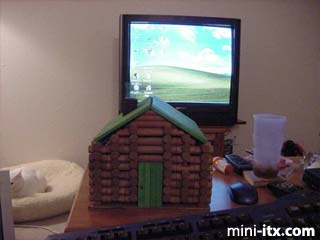
Looking back at this old Mini-ITX mod, it has occurred to me how simple it would be to adapt it to VIA's latest offerings. This log cabin case mod featured a VIA Mini-ITX motherboard. This could so easily be adapted to feature a VIA APC Rock motherboard.


Monday, September 23, 2013

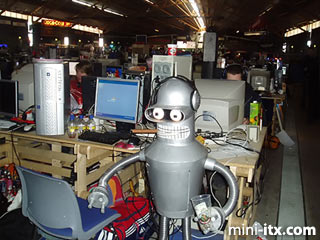
Case mod memory lane #7: Bender case

I actually saw this case mod in person at QuakeCon in 2005. It looks more like a movie prop than a computer. The dimensions are just right and the eyes and mouth have the right personality. This is one mini-ITX case mod where the VIA motherboard inside is not the star of the show!


"After the platform was made, everything went like a dream. The parts slotted right inside. I can thank myself for this due to careful planning and taking my time with the project. It actually took 3 months longer than planned." - Mini-ITX.com

Sunday, September 15, 2013

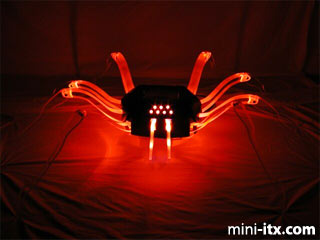
Case mod memory lane #6: The Spidercase

This mod is certainly one of the most creative and unique. Rather than putting a VIA EPIA Mini-ITX motherboard inside something that already exists, this mod was made from scratch. It was not without cost ...

"After cutting openings for the legs, I had to figure out how and what to make the legs with. Originally I had planned for the aluminum look but finding a cheap CNC cutter + blocks of aluminum in only a few days seemed nearly impossible. So I decided to go with my reliable source of acrylic at www.tapplastics.com. Since there was a local store within a mile of my house, I quickly made some templates and ran off to get some acrylic. About halfway through cutting the legs out, I stuck my middle fingertip into a table saw and found out first hand why people wear gloves. One stitch and 3 hours later I was back in the garage cutting again. I'll spare you the pictures. The thighs were 1-1/4" thick and only 6 were made at the time because the template picture I was going off showed only 6 legs on the spider. Later I changed it to 8. As I was cutting the lower portion of the legs, I routed my thumb and figured out for the second time why I should learn things the first time (wear gloves!!!@#). Since I couldn't use my right hand for the last few leg parts, I took them to Tap Plastics and they gladly cut out the shapes I needed cheap. This was after they laughed at me for cutting my hand for the 2nd time."


More on Mini-ITX.com.

Sunday, September 1, 2013

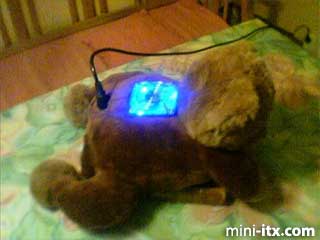
VIA case mod memory lane #5: The teddybear

It's all class this week with a look back at the computer case mod that has a teddy bear stuffed to the brim with a VIA EPIA-based computer.


Was that the best place for the power cord? Seriously though, it was good thinking to include a fan on the top. VIA embedded motherboards do run without passive cooling, but maybe not when they're inside a fur coat. More on Mini-ITX.com

Sunday, August 25, 2013

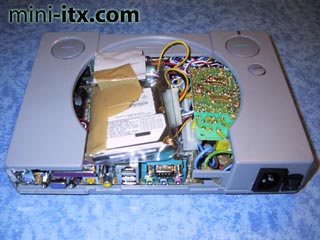
VIA case mod memory lane #4: The Playstation PC

It's ironic that consoles really do have the innards of a PC these days and in this mod, Per Samuelsson, gutted an old-school, grey Playstation and crammed inside a VIA EPIA Mini-ITX board 6GB hard drive, 256MB RAM, 145 Watt PSU, power switch, power connector and an extra fan. It was a tight squeeze.


"The EPIA mainboard fits exactly into a Playstation chassis, what luck! Of course I had to remove the gameports - to make them look like real gameports I filed them down until I had a 2.5mm thick frame, then glued the memory flaps into place and fitted the controller pins on black cardboard. Now they really looked like real Playstation gameports. I installed the Ram on the mainboard and tried to fit the cover. Fat chance Buster! It was too high. Dremel, Dremel, Dremel..."

It looks like someone's trying to smuggle something in there! Full story on Mini-ITX.com


Sunday, August 11, 2013

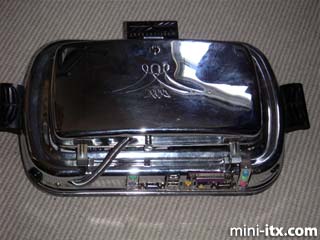
Case mod memory lane again: the waffle iron

The chrome casing to this waffle iron provided a classy look to an otherwise cooky mod for the VIA EPIA M1000.


Find out more on Mini-ITX.com.

Monday, July 1, 2013

The Mini-ITX cluster proves forever popular

Over on Mini-ITX.com, the right border of the popular site shows the most viewed content that day. Fourth on the list is a blast from the past, from February 2004, the build of the 12 node mini-cluster, powered by the VIA EPIA V8000.


The write-up of the project is no Dan Brown novel, so it must be the content that has people visiting so much some nine years later. Or maybe it's just that it looks so darn cool!

"I built a Mini-ITX based massively parallel cluster named PROTEUS. I have 12 nodes using VIA EPIA V8000, 800 MHz motherboards. The little machine is running FreeBSD 4.8, and MPICH 1.2.5.2. Troubles installing and configuring Free BSD and MPICH were few. In fact, there were no major issues with either FreeBSD or MPICH. The construction is simple and inexpensive. The motherboards were stacked using threaded aluminum standoffs and then mounted on aluminum plates. Two stacks of three motherboards were assembled into each rack. Diagonal stiffeners were fabricated from aluminum angle stock to reduce flexing of the rack assembly."

Tuesday, October 16, 2012

The VX11H debuts quietly

Blink and you will have missed the new VIA chip on the EPIA M-920 released last month. The new chip features on VIA's latest Mini-ITX board, but it didn't garner its own Press Release. Let's take a look at the new chip.

Oh, wait, that's kind of hard to do since the chip doesn't even have a page to itself on VIA's website.

The VX11H is presumably an upgrade from the VX11, which is a media system processor with DirectX11 capability. The key features of the VX11 are:


  • High Performance Hardware HD Video Decoder: Smooth hardware acceleration for MPEG-4, H.264, MPEG-2, and VC-1 for advanced browser streamed video technologies
  • Advanced Display Connectivity: Supports the latest display standards including DisplayPort, HDMI, DVI and VGA in multi-display configurations
  • DX11 Graphics Performance: The VIA Chrome 640/645 integrated graphics processor is fully DirectX 11 certified and includes a 128-bit 2D engine
  • SuperSpeed USB Certification: Has received SuperSpeed USB certification form the USB-IF and supports up to 3 USB 3.0 ports
  • HD Audio support: VIA Vinyl HD Audio controller supports up to eight high definition channels with a 192kHz sampling rate, delivering a richer all-round digital media experience
  • Memory Support: Memory controller technology supports the lower power, high-bandwidth DDR3 memory modules with speeds up to 1600MHz
  • Fully Integrated technology support: Supports the low power device interfaces of SDIO 3.0, UART, SPI, LPC as well as six USB 2.0 ports
It's not clear what the difference is between the VX11 and the VX11H.

Monday, March 26, 2012

A living legend of Mini-ITX PC modding

Jeffrey Stephenson is a named you have probably come across over the years if you find yourself reading news about VIA, about small form factor PCs or about case modding. Jeffrey's designs don't involve a fun but crude gutting of an old appliance, they are carefully planned and meticulously executed masterpieces.

Jeffrey and his work have been honoured in an article in SiliconValleyWatcher. His passion for modding began with a VIA Mini-IT board:

"Stephenson bought one of the first mini-ITX form factor motherboards by VIA Technologies in 2003. He liked the idea of having a small, high performing computer. He had trouble finding a case that wasn't expensive or boring. "Then I stumbled across a site that sold wooden desktop cigar humidors, which had perfect dimensions and a stylish exterior," he said."

Sunday, February 26, 2012

VIA still leading the embedded field

VIA invented the Mini-ITX platform ten years ago and it's now used by Intel and AMD as well to offer fully featured boards to embedded developers. VIA is still leading the way though, launching the world's first quad core Pico-ITX boards last Friday.

The VIA EPIA M900 and M910 feature the VIA 1.2GHz QuadCore E-series processor.

"The VIA QuadCore E-Series processor features a highly optimized, energy efficient multi-core architecture, which is natively 64-bit compatible and comes with a host of additional performance features including Adaptive Overclocking. To meet the low power demands of the embedded market, the VIA QuadCore E-Series processor offers industry-leading energy efficiency, with the VIA QuadCore E-Series 1.2+ GHz processor delivering a thermal design power (TDP) of only 27.5W. The distributed power of the VIA QuadCore E-Series processor makes it ideal for handling the most demanding HD video formats for immersive multi-display applications and environments."

By continuously improving the hardware offerings on embedded boards, VIA will ensure its longevity well past its first decade of innovative design.

Thursday, January 26, 2012

Ports Galore!

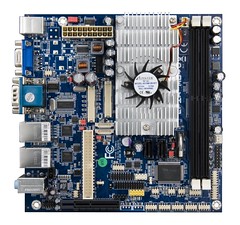
Windows for Devices have done their usual in-depth look at VIA's new VB7009 Mini-ITX board. Their overview reveals just how port-friendly this board is:

"The VB7009 supports up to 4GB of DDR3 memory, provides eight USB 2.0 ports and up to six serial ports, has two gigabit Ethernet ports, and offers a PCI expansion slot, according to the company."

The VB7009 is designed for kiosk and PoS applications and the multitude of connectivity options no doubt let developers explore many options.

Tuesday, January 3, 2012

VIA Promotes their eBook and gives away a new VE-900


I just got an email about a new competition that VIA is running to promote their 'Small is Beautiful: 10 Years of Mini-ITX' book. Download a free copy of the eBook version, check out the featured mods, let VIA know which is your favorite and why, and you could win a hardy copy of the book and a VE-900 Mini-ITX board to create your own mod.

Check it out.

Tuesday, December 27, 2011

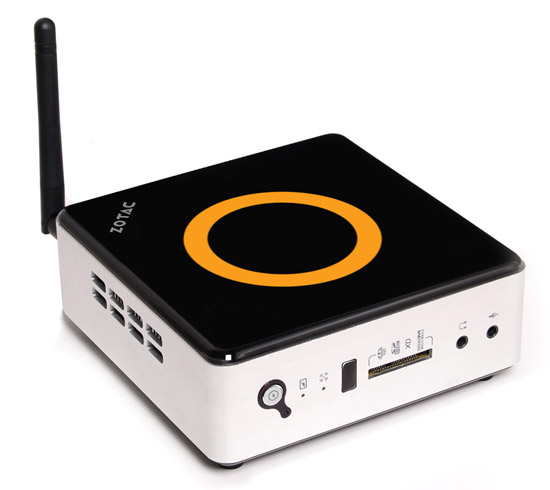
Build a Dedicated BitTorrent Box with a ZOTAC

VIA Mini-ITX motherboards have long been used as file servers; Linux boxes, home data storage and even as servers in cloud storage data farms. This new guide from LegitReviews explains, in quite a bit of detail, how to build a BitTorrent dedicated machine with a ZOTAC ZBOX Nano.


"We were lucky enough to get our hands on a new ZOTAC ZBOX Nano that is powered by VIA’s Nano X2 CPU. The ZOTAC PC comes in two flavors: One that is a bare-bones PC with only the CPU installed or a model that is fully outfitted with memory and hard drive. The price for the barebones PC is $169.99 plus shipping, while the the Zotac ZBOX Nano with HDD and DRAM included is $249.99 shipped. The VIA Nano X2 contains the VIA VX9 00H chipset that is designed to deliver an low-cost and energy-efficient micro-PC solution."

An introduction to Mini-ITX on eHow

eHow is like the Wikipedia for DYI, with 'contributors' publishing guides on all sorts of topics. On Christmas Eve, and article was published on "Mini-ITX Performance". The article largely provides an introduction to VIA's Mini-ITX platform, with quite a focus on Mini-ITX and its place in the VIA story.

"VIA developed the Mini-ITX for use their ultra low-power Eden and C3 microprocessors; however, other computer parts manufacturers adapted the specification to allow netbook processors like the AMD C- and E-Series and the Intel Atom. Read more: Mini-ITX Performance"

eHow.com http://www.ehow.com/info_12212968_miniitx-performance.html#ixzz1hmSV9Uy8

Monday, December 12, 2011

Just add RAM, storage and power


At USD$89 the new VIA VE-900 Mini-ITX board is an alluringly inexpensive way to build a PC that is well set up for multimedia use. BIOSLEVEL.com have reviewed the new board with pleasing results.

"I'm not sure I've ever seen a Via chip outperform a competitor from Intel, but the VE-900's 1.4GHz Nano X2 processor accomplishes this without breaking a sweat or needing overclocked. Paired with 8GB of RAM, I found the performance from the VE-900 to rival that of desktop systems from only a few years ago, all while using a fraction of the power."

With the right packaging and marketing an astute start-up could revitalise the desktop market with and affordable small form factor PC based on the VE-900.

Monday, June 13, 2011

Home system integration interested in ZOTAC ZBOX


A site dedicated to home automation picked up on VIA's recent announcement about the ZOTAC ZBOX Mini-ITX system. They commented that "While perhaps they may not pack enough power for doing much beyond streaming content or surfing the web, often this is what most people are after in the first place when it comes to their Home Theater PC (HTPC) and leave the more CPU intensive applications for the beefier computers in the home."

Like home automation devices, the ZOTAC ZBOX offers a function, in this case of a lounge room entertainment device, rather than simply being a regular PC stuck in a lounge room.

Thursday, June 2, 2011

New VIA VB8004 offers mutliplicity of display options


VIA has announced a new Mini-ITX board targetting the digital signage segment. The VB8004 can support up to four displays, but with all different sorts of connections if need be. This makes it super-adaptable.


To get the full four display support you actually need to add an S3 graphics 5400E module, and then you can hook up HDMI, LVDS and DVI.

The VX900 chipset on the board supports 1080p and DirectX10.1. - Press Release.

Thursday, September 9, 2010

Lian Li launches two new Mini-ITX cases


We all know that VIA invented the Mini-ITX platform, but Lian Li has been a huge supporter of it from the very beginning, offering quite a variety of case types.
This latest design has been made to fit behind a monitor making it ideal for point of sale, kiosks, etc. The VESA kit is just an option, however, as it can also be used as a desktop PC ... all be it a small one.
All VIA EPIA Mini-ITX boards would fit in the new Lian Li Mini-Q PC-Q09 and PC-Q09F chasis.

Tuesday, June 29, 2010

New Mini-ITX board targets intelligent industrial devices

I am straining to remember the last time VIA launched a new Mini-ITX board. It might even have been last year. There's been Em-ITX and Pico-ITX but it's been a while since there's been a new Mini-ITX. It's still the most popular embedded system platform.

The new EPIA-M840 "ticks all the boxes" for industrial and factory management applications.

"The VIA EPIA-M840 packs the latest 64-bit VIA Nano E-Series processor, dual Gigabit LAN, eight COM ports and support for two dual channel 24-bit LVDS displays, creating the ideal backbone for a range of embedded applications including intelligent industrial automation applications that integrate remote network access, network management and other advanced application management scenarios."

These industrial systems required quite a kick and the EPIA M840 delivers, with 1.2GHz and 1.6GHz options, DirectX9 capable graphics, HD audio, dual gigabit networking, 3GB DDR2 RAM support, 8 COM ports, four USB and 2 dual channel 24-bit LVDS support.

Tuesday, May 4, 2010

EPIA-M830: Getting to the specifics


VIA's EPIA range of motherboards are getting more and more targetted lately. Embedded computing is such a speciality field and VIA are pumping out Mini-ITX boards that meet the criteria for explicit uses, in this case POS, kiosk and POI applications.

"The VIA EPIA-M830 is designed to take the kiosk to this next phase, providing the backbone of devices that offer cashless purchasing and self service infrastructures in supermarkets and gas stations as well as more secure and interactive, multimedia-rich POI, lotto and gaming machines."

VIA are clearly thinking about the future here, although they must also be responding to demand. Somewhere out there are embedded developers dreaming up designs for embedded computers that will enhance our visit to the zoo, or streamline the process of getting a ticket for the train. I just hope they're a little bit smarter than the auto-checkout at Woolworths! - VIA