VIA's Nano processors are single core at the moment, they should be dual core by the end of the year and apparently they'll be quad core by the end of next year. When VIA released its monthly sales figures for August, the Press Release unsually included a few tid bits about future plans.
A VN11 chipset with DirectX support with support the new quad cores, providing more juice to the embedded computing space than ever before.
VIA's focus will still be on low power and I'd suggest the new chips will be aimed at enterprise level storage and server solutions and not at your next desktop.
Source: Thing.co.uk
Showing posts with label VIA Nano. Show all posts
Showing posts with label VIA Nano. Show all posts
Thursday, September 9, 2010

Tuesday, September 7, 2010
VIA releases new Mini-ITX board with HD everything

The new EPIA-M850 has HD audio, HD video playback and a HMDI port. It's not hard to tell that it's targetted at multimedia systems. Being in the Mini-ITX form factor, it's specifically aimed at embedded multimedia systems. At a consumer level, this board would also kick-ass for a lounge room PC.
Onboard is a 1.3 or 1.6GHz VIA Nano E-series processor and the VX900 single chip solution. The combination brings a lot of HD power to the table, whilst still retaining VIA's unique low profile, low noise and low power consumption traits.
"The VIA ChromotionHD 2.0 video engine boasts comprehensive hardware acceleration for the latest VC1, H.264, MPEG-2 and WMV9 HD formats at screen resolutions of up to 1080p without affecting CPU load. Display connectivity support includes onboard HDMI and VGA ports with pin headers for dual channel 24-bit LVDS.
The VIA VX900 boasts the VIA Chrome9™ HCM 3D integrated graphics core with full DirectX 9.0 support and a 128-bit 2D engine with hardware rotation capability. The VIA VX900 also features the VIA Vinyl HD audio codec. Storage includes ports for two SATA drives. "
The board can also handle up to 8GB of DDR3 RAM. The EPIA-M850 sure does pack a HD punch! More from the Press Release.
Wednesday, August 4, 2010
VIA announces new COM Express Mobule. Uses Nano processor
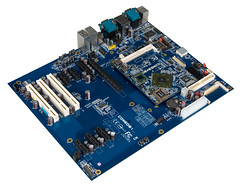
VIA usualy expend their efforts on promoting their own embedded platforms. Their Mini-ITX especially, but also the Pico-ITX, are now industry standards in the embedded industry. So to is the COM Express form factor, developed by the PICMG (PCI Industrial Computer Manufacturers Group).
VIA has just announced a new COM Express module which makes nice work of using the VIA Nano E-series processor and the VX800 digital media chip. The press release points out the products highlights:
* High performance, 64-bit VIA Nano E-Series processor
* 18/24-bit dual channel LVDS plus VGA support
* 3 PCI, and one x4 plus two x1 PCIe slots
* Up to 2GB of DDR2 SO-DIMM memory
* 10/100Mbps Fast Ethernet
* Up to six USB 2.0 ports
* Up to two SATA devices plus 1 IDE
In some ways this new module is an upgrade to the COME7N80 which uses the older VIA Eden processor.
The COME8X80 is available for OEM and ODM clients now, and for Australian companies, that probably means going direct to VIA's head office.
Wednesday, June 9, 2010
Dual core Nano spotted at Computex
Aptly described as "a bit of a unicorn" the VIA Nano in dual core form was never the less on display in a desktop system at Computex last week. Engadget had this to say:
"The device utilized a VN1000 Digital Media Chipset and fully supported dual-channel DDR3 memory. A Chrome 520 GPU was helping to push out a 720p movie trailer on the demo system, and the innate compatibility with HDMI and DisplayPort should keep home cinema owners happy. The 65nm chip was clocked at 1.6GHz, and we were told that it wouldn't be venturing into mobile machines in its current form."
A dual core Nano could form the basis of a low cost desktop PC that would suit most people's computing needs ... and it would also give a boost to the computing power afforded to embedded devices, if it makes its way to EPIA boards.
"The device utilized a VN1000 Digital Media Chipset and fully supported dual-channel DDR3 memory. A Chrome 520 GPU was helping to push out a 720p movie trailer on the demo system, and the innate compatibility with HDMI and DisplayPort should keep home cinema owners happy. The 65nm chip was clocked at 1.6GHz, and we were told that it wouldn't be venturing into mobile machines in its current form."
A dual core Nano could form the basis of a low cost desktop PC that would suit most people's computing needs ... and it would also give a boost to the computing power afforded to embedded devices, if it makes its way to EPIA boards.
Tuesday, April 20, 2010
New VIA ARTiGO targets consumers

The latest VIA ARTiGO system, just launched by VIA, is targetting regular consumers and enthusiasts. Previous VIA ARTiGO designs were aimed for use as servers. The ARTiGO A1100 would also be perfect for that but the new configuration also aims to appeal to general desktop use as well.
The new white chassis is pretty spiffy looking, complete with a little swirly design. It looks just as cute as the first ARTiGO but the white color is somehow more friendly than the black. The measurements are 14.5 x 10 x 5 cm and that makes it the smallest full featured PC kit available. It is full featured, with a 1.2GHz VIA Nano 64-bit processor and the VX855 digital media chipset which gives it HD playback support. Being so small, it doesn't have room for an optical drive but you could always plug in a USB optical drive.
The new white chassis is pretty spiffy looking, complete with a little swirly design. It looks just as cute as the first ARTiGO but the white color is somehow more friendly than the black. The measurements are 14.5 x 10 x 5 cm and that makes it the smallest full featured PC kit available. It is full featured, with a 1.2GHz VIA Nano 64-bit processor and the VX855 digital media chipset which gives it HD playback support. Being so small, it doesn't have room for an optical drive but you could always plug in a USB optical drive.
As a media box for the lounge room, that compliments a DVD/Blu-ray player, and is responsible for playing DivX, AVI and other media file types, the ARTiGO A110 is really pretty awesome. The etail price, for US residents only, is USD 243. It has HDMI and VGA out (and audio of course). That's not a bad deal, especially when you look at how much space it would take up ... or more to the point, how much space it wouldn't take up. Having the audio ports on the front and the VGA and HDMI on the back is not ideal though as there would be no way to avoid having cables sticking out the front of it.
As a desktop PC it's also a very sweat deal. It would take up less room on a desk than you're average phone!! The specs are also more than capable of most people's working requirements.
The Press Release says that it supports Windows 7, Vista and XP but the product page on VIA's site omits Vista. Not sure what the deal is there but my guess is that it's on oversight on the website.
Sadly, no online sales place is listed for Australia. Mini-ITX.com do ship internationally though. You can also try and win one in VIA's ARTiGO A110 simile game. The competition is open until next Thursday 29th. The idea behind the comp is that people submit images of things that the ARTiGO A110's size reminds them of and then people vote for their favorite. My tip would be to go for something funny.
Tuesday, March 30, 2010
M'SERV great product for VIA's server line up

Homes and offices are having to deal with more and more data and there are two options - 1) store your data in the cloud or 2) invest in your own server. The M'SERV from VIA aims to serve the latter. It can support up to 4TB of storage which should be enough for small to medium business and bit-torrent home users alike.
"The M’SERV S2100 from VIA is the perfect next step for the company in taking their barebones home and small business server solution forward. The S2100 retains everything that made the Artigo A2000 a success – (small footprint, low cost, ease of build) and solves its major achilles heel, replacing the C7 with the 64-bit Nano processor. That unlocks a much needed hardware compatibility path for those wishing to run Windows Home Server today and Vail when released." - WeGotServed.com
"The M’SERV S2100 from VIA is the perfect next step for the company in taking their barebones home and small business server solution forward. The S2100 retains everything that made the Artigo A2000 a success – (small footprint, low cost, ease of build) and solves its major achilles heel, replacing the C7 with the 64-bit Nano processor. That unlocks a much needed hardware compatibility path for those wishing to run Windows Home Server today and Vail when released." - WeGotServed.com
Wednesday, September 2, 2009
VIA Launches ACE Connects (ACE-CNX)

VIA’s Eden, C7 and Nano processors have an advanced cryptographic engine built right into the die of the processor. ACE-CNX, pronounced ACE Connects, is a new service that connects developers with experts within VIA, to help developers build successful secure applications using the ACE security engine provided with VIA’s CPUs.
VIA have justed announced their Security Solution Service, now known as ACE-CNX. The service will be available through the VIA Embedded Platform Division (VEPD) and like an engineering fee for new board designs, the cost will depend on the project and will be considered on a case by case basis. Customers would work with VIA’s software engineers to develop a solution specifically tailored to their needs.
With ACE-CNX, VIA engineers and the developers would work together to define the hardware setup and what they want to achieve, and then VIA would provide a tailor-made SDK (software development kit) for the company to work with. ACE-CNX would then have VIA work with the company until the solution is finalized.
To understand why the ACE-CNX solution is important, let me first explain how VIA’s embedded security works. Ordinarily, security measures don’t take effect until after the operating system has loaded. With VIA’s solution, key system files can be verified before booting starts, ensuring the integrity of files before the operating system loads. It’s all about booting securely, and then using an operating system and applications securely. In VIA’s solution, the security red tape all happens between the CPU and the memory and with the software element removed, this drastically reduces the complexity of keeping things secure.
ACE-CNX itself is not software and it’s not hardware, it’s a service where VIA helps its customers to exploit this unique security engine in the VIA Eden, C7 and Nano processors.
In case you’re confused, as I certainly was when I started to research this blog, I’ll provide a few hypothetical examples of why a company might decide to sign up for the ACE-CNX service. In all cases, the company in question is developing a product with features that require excellent security and this might include:
Communication: Traditionally, to set up secure communication, you need to set up a VPN tunnel. With VIA, instead, it’s end to end.
Digital signage: Content being displayed on digital signage can be securely remote managed.
Secure file sharing: Large organizations can secure file access between notebooks, desktops and servers.
This is by no means an exhaustive list of the practical circumstances where the ACE-CNX service would help VIA customers. And it doesn’t matter what the infrastructure is, so long as it includes a VIA Eden, C7 or Nano processor; it can be a custom board, EPIA board, VB series board, etc.
In all cases, the goal is to make best use of the AES algorithm and utilize the opcodes in VIA processors to encrypt data and thereby keep that data secure. Rather than struggle to keep data secure by software, VIA’s solution keeps information safe using the circuitry in the computer itself. ACE-CNX is the service that forms a partnership between VIA and their customer to make it happen for a particular product and application.
We’d like to thank Patty Wu, Steven Wang. Peter Li, Stewart Hatson and Timothy Brown from VIA for their time in providing information for this blog post.
VIA have justed announced their Security Solution Service, now known as ACE-CNX. The service will be available through the VIA Embedded Platform Division (VEPD) and like an engineering fee for new board designs, the cost will depend on the project and will be considered on a case by case basis. Customers would work with VIA’s software engineers to develop a solution specifically tailored to their needs.
With ACE-CNX, VIA engineers and the developers would work together to define the hardware setup and what they want to achieve, and then VIA would provide a tailor-made SDK (software development kit) for the company to work with. ACE-CNX would then have VIA work with the company until the solution is finalized.
To understand why the ACE-CNX solution is important, let me first explain how VIA’s embedded security works. Ordinarily, security measures don’t take effect until after the operating system has loaded. With VIA’s solution, key system files can be verified before booting starts, ensuring the integrity of files before the operating system loads. It’s all about booting securely, and then using an operating system and applications securely. In VIA’s solution, the security red tape all happens between the CPU and the memory and with the software element removed, this drastically reduces the complexity of keeping things secure.
ACE-CNX itself is not software and it’s not hardware, it’s a service where VIA helps its customers to exploit this unique security engine in the VIA Eden, C7 and Nano processors.
In case you’re confused, as I certainly was when I started to research this blog, I’ll provide a few hypothetical examples of why a company might decide to sign up for the ACE-CNX service. In all cases, the company in question is developing a product with features that require excellent security and this might include:
Communication: Traditionally, to set up secure communication, you need to set up a VPN tunnel. With VIA, instead, it’s end to end.
Digital signage: Content being displayed on digital signage can be securely remote managed.
Secure file sharing: Large organizations can secure file access between notebooks, desktops and servers.
This is by no means an exhaustive list of the practical circumstances where the ACE-CNX service would help VIA customers. And it doesn’t matter what the infrastructure is, so long as it includes a VIA Eden, C7 or Nano processor; it can be a custom board, EPIA board, VB series board, etc.
In all cases, the goal is to make best use of the AES algorithm and utilize the opcodes in VIA processors to encrypt data and thereby keep that data secure. Rather than struggle to keep data secure by software, VIA’s solution keeps information safe using the circuitry in the computer itself. ACE-CNX is the service that forms a partnership between VIA and their customer to make it happen for a particular product and application.
We’d like to thank Patty Wu, Steven Wang. Peter Li, Stewart Hatson and Timothy Brown from VIA for their time in providing information for this blog post.
Tuesday, August 11, 2009
Gamble away or have fun with AEWIN
"GA-1000, the entry level all-in-one gaming board, is suitable for use in slot machines, amusement gaming machines, lottery machines, fruit machine, slave unit of roulette machine, and server-base gaming machines." That's the word from Embedded-computing.com. The new AEWIN GA-1000 has a choice of a 500MHz or 1GHZ VIA Eden processor or a VIA Nano at 1.6GHz. That's quite a bit of difference in processing power between models. The Nano version is recommended for applications with dual displays.
Monday, August 3, 2009
New ETX board from AAEON
VIA's processors may soon find themselves responsible for entertaining folks, with the announcment of some new boards from AAEON, designed for high end entertainment devices.
"According to the specifications of the new board, customers will be provided with a 4.5 x 3.7-inch ETX COM format that boasts a 1.6GHz VIA Eden or a 2.0GHz VIA C7 processor, combined with VIA's fully integrated CX700M media system processor, or chipset. Dubbed EXT-CX700M, the board has been designed to support up to 1GB of DDR2 memory." - Softpedia.com.
"According to the specifications of the new board, customers will be provided with a 4.5 x 3.7-inch ETX COM format that boasts a 1.6GHz VIA Eden or a 2.0GHz VIA C7 processor, combined with VIA's fully integrated CX700M media system processor, or chipset. Dubbed EXT-CX700M, the board has been designed to support up to 1GB of DDR2 memory." - Softpedia.com.
Subscribe to:
Posts (Atom)